

Intuit adds AI tools to Enterprise Suite for mid-market
Mon, 18th May 2026
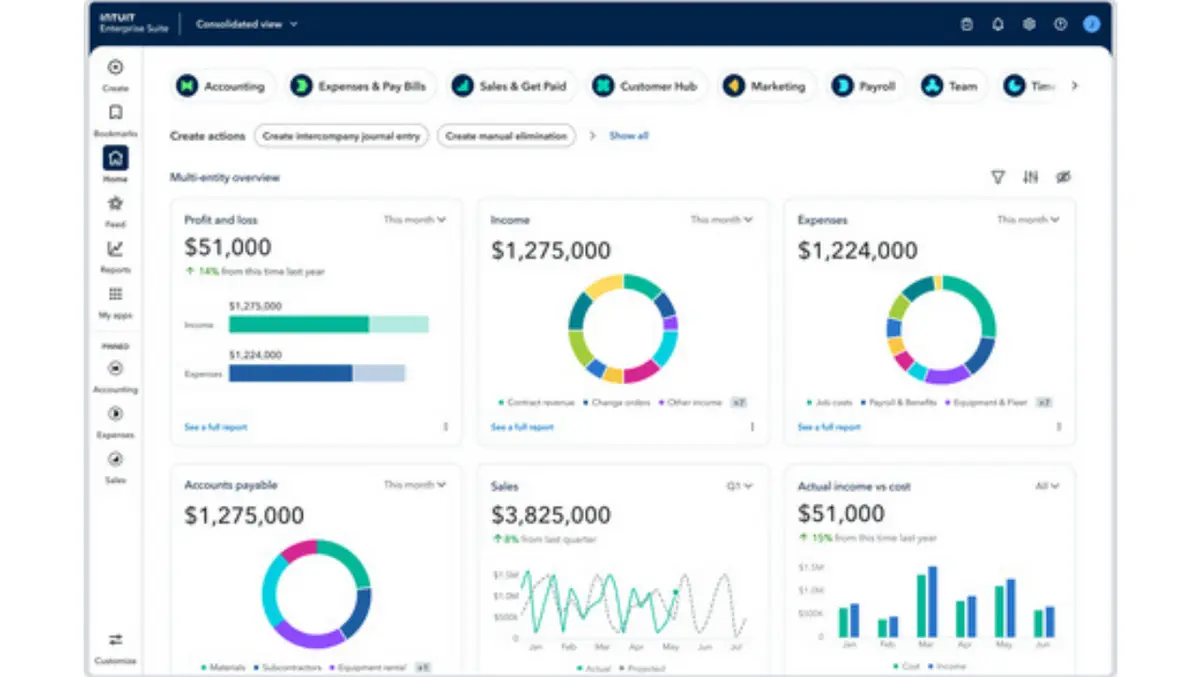
Intuit has added new features to Intuit Enterprise Suite for mid-market businesses, expanding the software's finance, reporting, construction and workforce management capabilities.
The update focuses on multi-entity accounting, dimensional reporting, construction workflows and an integrated human capital management offering. It is aimed at businesses managing more complex operations across multiple entities, projects or locations.
Intuit is positioning Enterprise Suite as an alternative for mid-market groups that have outgrown small-business software but do not want to move to more established enterprise resource planning systems. The platform can manage more than 200 entities and combines financial management, reporting, payments, bill pay, project profitability, payroll, HR, and marketing into a single system.
A conversational chat interface is also being introduced in beta for eligible customers. It is designed to automate recurring tasks and turn manual steps into workflows handled by virtual AI agents.
Ashley Still, GM and EVP of Small Business and Mid-Market at Intuit, described the challenge facing finance teams working across disconnected software tools.
"For too long, mid-market finance teams have been forced to make critical decisions with fragmented data spread across disconnected systems," Still said. "Intuit Enterprise Suite brings operational, financial, and workforce data together in one place, giving the office of the CFO real-time visibility and the confidence to move from closing the books to shaping what happens next."
Financial close
One of the main additions addresses the financial close process for businesses with several legal entities. Enterprise Suite now supports automated cross-entity accounting workflows, including transaction-level intercompany eliminations and spreadsheet-based journal entry uploads.
Users can also create multiple entity hierarchies to reflect tax, legal and operational structures. Another new feature uses AI to suggest categories for bills generated from intercompany sales, while cross-company bill pay can automatically create related intercompany journal entries.
The additions are intended to reduce manual reconciliations at period end, a common pain point for growing finance teams. Intuit linked the release to the needs of businesses expanding through acquisitions or operating through multiple subsidiaries.
"What I love about Intuit Enterprise Suite is the intercompany transactions," said Emily Most, VP of Finance and Administration at Certified Industrial Partners. "Not only does our team get to save about 10 hours a week, but we were able to allocate that responsibility across multiple team members because it doesn't take as much accounting experience to complete."
Another customer pointed to the software's role in post-acquisition integration.
"We made six acquisitions in 18 months," said Josh Daneshforooz, CEO of Lango. "With Intuit Enterprise Suite, we don't have to switch systems - every new business integrates seamlessly. That's a game changer."
Reporting tools
Intuit has also expanded reporting with what it calls dimensions, allowing finance teams to group columns and filter financial and sales reports based on how a business is organised. Default dimensions can now be set for customers, vendors and projects, removing the need to assign them manually to each transaction.
The reporting update also includes peer benchmarking based on transaction data from millions of businesses. This is intended to let customers compare their performance by industry, revenue band and location.
"Access to all the data and intelligence helps point us to things we could be missing," said Ed Sutton, owner and CFO of MDR Realty, LLC. "This is the game changer."
"With IES, it allows us to drill down," said Brandon Webster, Director of Finance at PULSEROLLER. "Ownership can see a better snapshot of how the company in total is doing, providing the visibility needed to see truly profitable primary business lines versus R&D expenditures."
Industry analyst Mickey North Rizza said mid-sized businesses stand to benefit from software that automates workflows and expands financial visibility without creating a heavy internal implementation burden.
"Mid-sized businesses are often operationally complex, with multiple locations, diverse product lines, and layered organisational structures," said Mickey North Rizza, Group Vice President of Enterprise Solutions at IDC. "This positions them to benefit from the latest wave of AI-powered ERP solutions, especially those that automate workflows, improve financial visibility, enable faster decision-making, and are designed to scale without overwhelming internal teams."
Construction focus
For construction customers, Intuit has expanded features in the construction edition of the Enterprise Suite. The additions include a broader project management agent, more detailed work-in-progress reports and more flexible job costing.
These tools are intended to improve visibility into estimates, actuals, billings, margins and cash flow across the life of a project. Construction businesses often rely on a mix of accounting systems, spreadsheets and specialist project tools, making it harder for finance leaders to track profitability before a job is complete.
"One of the biggest roadblocks for a CFO in construction is visibility," said Scott Franchini, Partner at RedHammer. "You may not know whether a job is profitable until the project is already over. What IES brings to the table is the ability to quickly see budgets, actuals versus budget, billings, and gross profit on a specific project."
Workforce data
Alongside the finance and project features, Intuit has made its new human capital management product available within the Enterprise Suite. The workforce software covers payroll, time tracking, benefits, hiring, recruiting and performance management.
Customers can now manage workforce and financial data on the same platform. The goal is to improve data accuracy and give businesses a broader operational view without relying on separate HR systems.
The new AI features, HCM integrations and construction-specific workflows are being rolled out to US-based Intuit Enterprise Suite customers.