

AI transforming B2B discovery - but human trust endures
Sun, 20th Sep 2026 (Today)
Artificial intelligence is changing how B2B buyers discover and assess potential partners, but human expertise, credibility and relationships remain critical to winning deals.
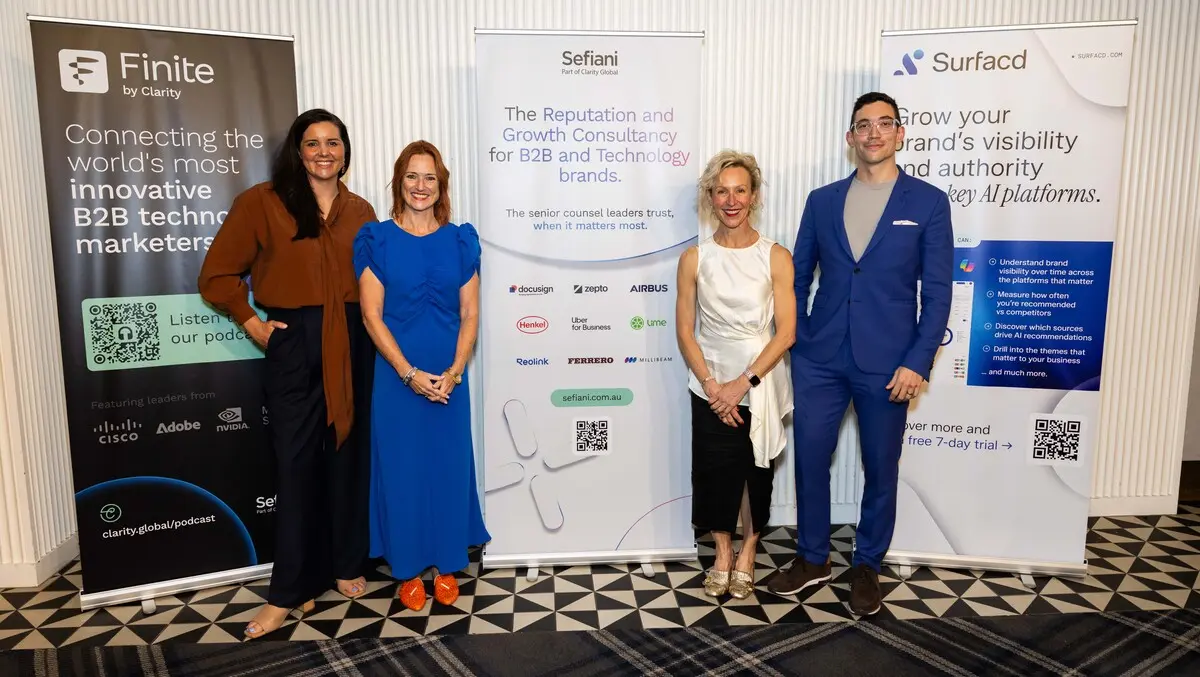
That was the prevailing sentiment from the Sefiani B2B leaders meet-up in Sydney, which brought together journalists, PR professionals and marketing executives.
Mandy Galmes, Managing Partner Australia at Sefiani, said Australian buyers are increasingly using AI tools during the early stages of purchasing decisions, while remaining sceptical about the information being presented.
She cited similar commentary from AI academic Toby Walsh, who describes Australians as fundamentally sceptical of the systems behind common AI tools.
This is creating a disconnect in the B2B buying process, Galmes said, with AI being used to find and shortlist partners, but human judgement then takes over when a purchasing decision needs to be made.
The changing discovery process has already produced a measurable commercial impact at B2B payment platform Zepto, said General Manager, Commercial, Emily Curlewis.
Zepto provides account-to-account payment infrastructure to businesses, financial institutions and payment platforms.
As many customers use its products behind the scenes, the company was often gagged from discussing customer wins publicly.
Consequently, it became difficult to consistently demonstrate its momentum in the market to attract new business.
At the same time, prospective customers were asking questions about PayTo, Australia's real-time account-to-account payment method, including whether it was working, who was using it and what use cases were emerging.
With industry bodies and government organisations not providing enough information to answer those questions, Zepto created the PayTo Index, which has since evolved into the Account to Account Index.
The report uses Zepto's proprietary data to examine payment activity and emerging use cases, allowing the company to establish an authoritative position around a subject directly relevant to its business.
Curlewis said the initiative was never designed simply as a PR campaign.
"It was a tool for our sales team," she said, explaining that enterprise sales cycles can be lengthy and require businesses to find reasons to maintain engagement with potential customers.
The content also provided Zepto with material for government engagement and policy advocacy, while helping establish the company as a credible source of information.
More recently, the company has been able to see its content contribute to AI-driven discovery.
Zepto is increasingly appearing in responses from ChatGPT and Claude.
"We're starting to see leads come in now that say, 'ChatGPT said I should talk to Zepto,"' Curlewis said.
That has provided the company with a direct link between communications activity, AI discovery and commercial opportunities.
AI not a replacement for effective human comms
Self-described AI realist, Fred Azis-Laranjo, Head of Communications, Pacific Zone at Schneider Electric, cautioned against perceiving generative AI optimisation as a replacement for established marketing and communications practices.
While acknowledging that AI is creating tactical changes, Azis-Laranjo said that the fundamental principles of effective communications had not changed.
He described the Zepto campaign as an example of an integrated, multi-channel approach that addressed a genuine customer information gap.
Schneider Electric is currently experimenting with GEO, including changes to website metadata and broader web hygiene, but Azis-Laranjo questioned whether businesses could reliably determine how individual LLMs source and rank information.
He added that the communications industry is still learning how different AI systems work, with approaches changing frequently, and strategies often encompassing multiple AI models that do not function uniformly.
AI appetite fluctuating across regions
Clarity Global, parent company of Sefiani, has observed an increase in B2B buyers using LLMs during their purchasing journeys.
However, Clarity CEO Rachel Gilley said adoption and approaches still vary significantly between different regions.
The US market is generally more willing to use AI for activities such as advertising optimisation and programmatic marketing, while European organisations are using it more for campaign delivery and efficiency.
Organisational structures and existing technology stacks are among the factors influencing those differences.
Businesses around the globe also face challenges around ownership, Gilley noted, with marketing, communications and other functions often operating in organisational silos without a unified AI strategy.
Clarity has developed tools designed to monitor how LLMs surface brands and the sentiment associated with them.
However, the results are evolving at a rapid pace, meaning companies need to continually monitor performance over time rather than treat GEO as a one-off exercise.
A campaign for work management platform Monday.com demonstrated the potential commercial and reputational impact.
Instead of measuring success solely through conventional media coverage, the team examined how LLMs responded to questions around the future of work and then shaped communications activity around those findings.
The campaign generated a 300 per cent increase in citations across the LLMs being monitored, Gilley noted, while visibility in Google AI increased from 5.7 to 11.2 per cent.
The example also helped demonstrate the value of communications to senior executives, with the company's senior communications director subsequently presenting the results to the board.
Gilley said the emergence of AI could give comms teams access to more detailed evidence about how their work influences brand visibility.
Organisations capable of breaking down internal silos can be more nimble, capable of making changes to AI-driven discovery strategies.
Curlewis said Zepto's experience had similarly strengthened the case for investment in communications and content.
Rather than measuring success through traditional media coverage, the payments platform can now examine whether it is appearing in the sources influencing AI systems.
That allows communications metrics to be linked more closely to sales and go-to-market objectives.
"It's really made the case for investment in quality comms and content more powerful," Curlewis said.
However, she warned that the push to create more AI-visible content could encourage businesses to prioritise quantity over quality.
Curlewis pointed to a recently published white paper from a competitor that had produced multiple sloppy errors, a clear sign of poorly prompted AI-generated content that could have also used a thorough proofread before publication.
That example reinforced the importance of maintaining editorial standards, Curlewis said, as businesses seek to increase their visibility across AI platforms.