

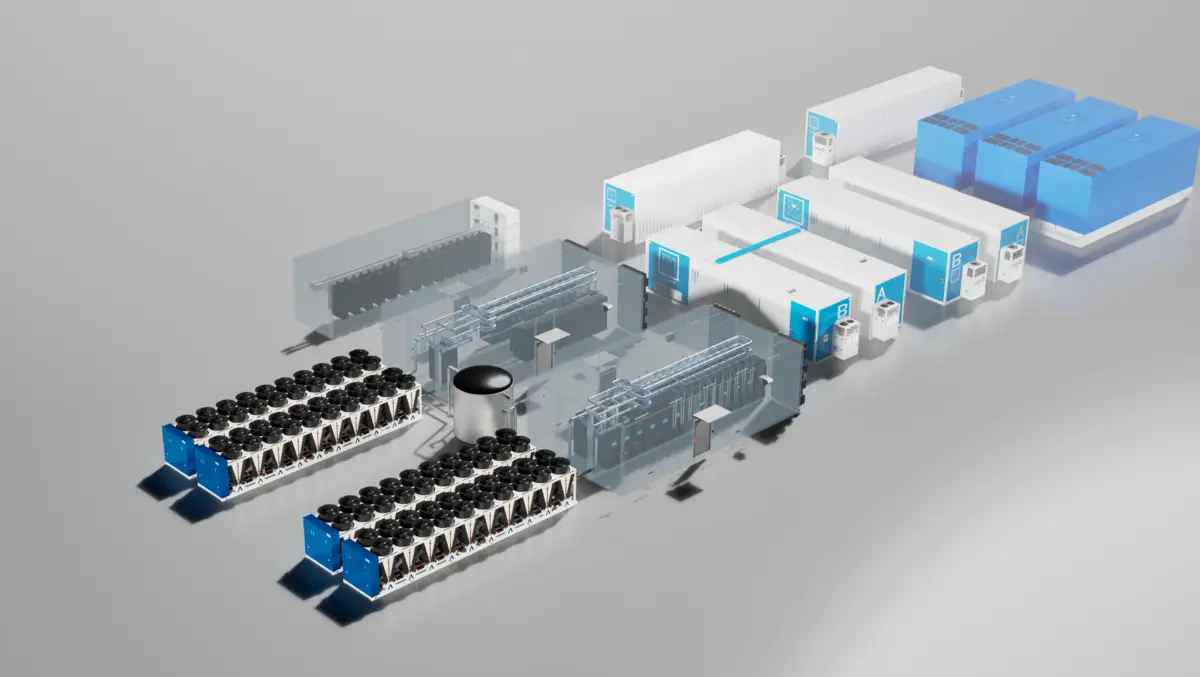
Airsys launches Arc90 to boost data centre compute power
Fri, 20th Nov 2026 (Today)
Airsys has launched Arc90, a thermal management architecture for data centres designed to allocate up to 90% of a site's provisioned electrical capacity to IT compute.
The launch marks a shift from selling individual cooling components to designing and pricing integrated, site-specific systems built around a metric the company calls Power Compute Effectiveness, or PCE.
Arc90 targets a problem that has grown more pressing as AI workloads drive demand for new data centre capacity: how much electrical power is lost to cooling and other supporting infrastructure before any servers are installed. The framework is intended to address that issue at the design stage, when developers decide how provisioned power is split between compute, cooling, electrical losses and ancillary loads.
Under the model, each project is designed, validated and priced against a target PCE of up to 0.90, depending on factors including facility boundaries, redundancy requirements, site conditions and customer needs. In practical terms, a site with 100 MW of provisioned capacity could allocate 90 MW to IT compute and 10 MW to cooling and support systems.
The framework combines air, liquid and hybrid cooling approaches within a single architecture. The process includes site-level thermal modelling, PCE-based architecture design, equipment selection, controls integration, commissioning, performance validation and lifecycle optimisation.
Yunshui Chen, Founder and Chief Executive Officer of Airsys, said the launch reflects a broader change in the company's operating model.
"The race to build AI infrastructure is now a race for power," said Chen. "The choices made before construction begins decide how much of that power is ever set aside for compute. Arc90 is how we intend to answer that question with our customers from the first drawing: one architecture, designed and priced around the outcome rather than a list of equipment."
Design approach
Conventional data centre cooling often routes all loads through a single chiller plant with one operating setpoint. Arc90 instead separates thermal loads into three loops with different temperature ranges.
A high-temperature liquid loop is intended for CPUs and GPUs and uses dry coolers and coolant distribution units. For compatible high-density systems, this loop can capture about 80% to 90% of server heat at source, and in suitable climates may reduce or eliminate compressor-based cooling for that load.
A medium-temperature loop uses free-cooling chillers for residual air-side heat, while a low-temperature zone uses precision DX cooling for electrical rooms, UPS areas and support spaces.
Separating the high-temperature and medium-temperature loops means chillers need to be sized only for residual air-side heat rather than the full IT load. In Airsys modelling, this can reduce required chiller capacity by up to 80% compared with a chillers-only design.
Arc90 is also designed to a zero evaporative water use effectiveness target, reflecting growing scrutiny of water consumption alongside electricity demand in data centre development.
Power metric
PCE is Airsys' measure of how much provisioned electrical capacity is assigned to IT compute within a declared facility boundary, compared with total provisioned facility capacity under a declared redundancy basis. Unlike Power Usage Effectiveness, which measures energy efficiency during operation, PCE is intended to measure power allocation decisions on paper before a facility is built.
In illustrative legacy designs assessed by Airsys, PCE can be about 0.70, meaning roughly 30% of provisioned power is assigned to cooling, electrical losses and other support infrastructure.
In one design model for a hypothetical 60 MW facility in the south-eastern United States, a chillers-only design reached a PCE of 0.74, while an Arc90 configuration targeted 0.90 using the same declared facility boundary and redundancy assumptions. That would represent about 22% more provisioned power for compute within the same total facility power, though results depend on assumptions about climate, IT load, cooling architecture and electrical losses.
Industry analysts cited by Airsys said the issue of power allocation is becoming harder to ignore as utilities, local communities and developers come under growing pressure over data centre resource use.
"In a power-constrained data center industry, every watt freed from physical infrastructure for AI computing is a win. PCE brings that priority into the design process, focusing on how much of a facility's provisioned power is available to IT rather than supporting infrastructure," said Vlad Galabov, Independent Data Centre Analyst and Host of The AIDC Debate. "Liquid cooling can help reduce cooling power demand, but capturing its full potential requires creative, whole-system thinking. Airsys is taking the right approach by treating cooling as a holistic challenge, addressing both new builds and retrofits of existing facilities."
Product lines
Arc90 will become the architecture standard across five product lines: PowerOne for data centre thermal management and high-density infrastructure; LiquidPack for retrofit liquid cooling in existing facilities; EdgeOne for modular thermal systems in edge, telecom and distributed sites; Aegis for chip- and component-level cooling; and ComfortOne for commercial and K-12 buildings.
LiquidPack is the new name for the company's direct-to-server liquid spray cooling platform, designed to retrofit servers in air-cooled halls to single-phase liquid cooling and increase rack density within the existing footprint. Airsys is working with server manufacturers, hyperscalers and colocation operators on instrumented trials benchmarked on PCE before and after retrofit.
For higher-density processors, Aegis is developing two-phase direct-to-chip cooling around a 3D-printed cold plate. Airsys said additive manufacturing allows internal structures that guide vapour away from the chip, increase the surface area where coolant boils and concentrate cooling on processor hotspots.
"As power availability becomes a growing constraint on data center development, operators need to look beyond operational efficiency and consider how effectively they allocate their available electrical capacity," said Rand Talib, Research Analyst at Uptime Institute. "Decisions made during the design phase determine how much capacity is reserved for IT equipment versus supporting infrastructure, with important implications for future expansion, infrastructure investment, and operational flexibility."