

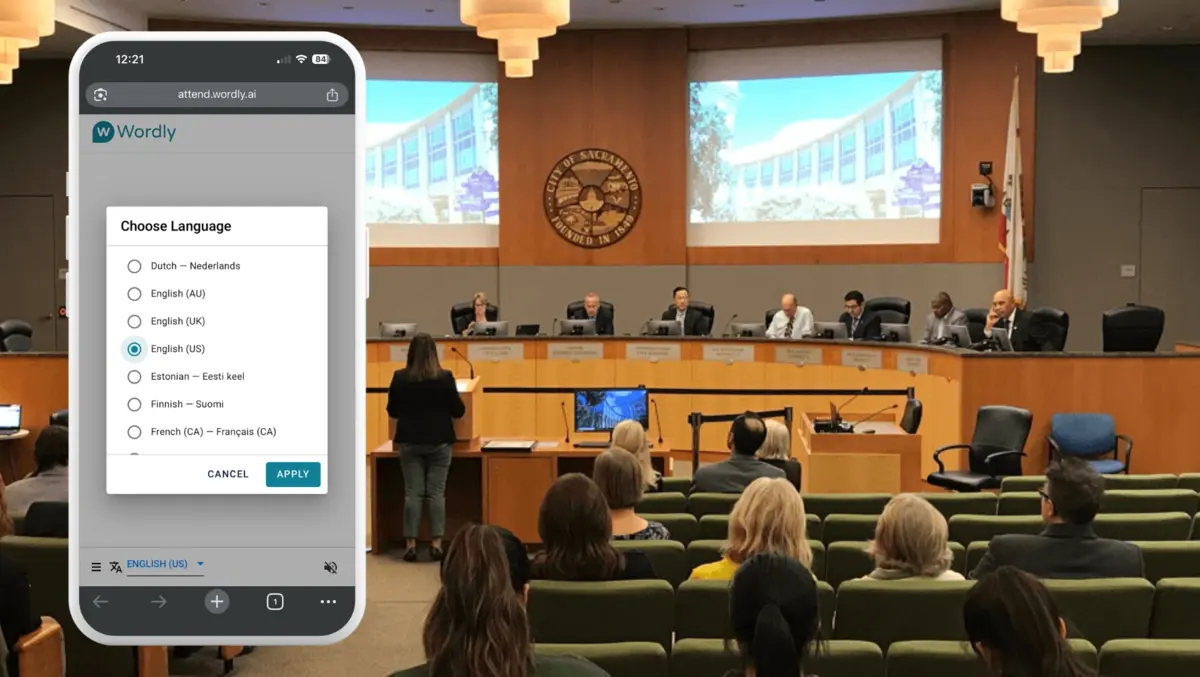

California public agencies are assessing new language access requirements under Senate Bill 707, as vendors and local authorities weigh the cost and practicality of multilingual services ahead of a July 2026 deadline.
SB 707 expands language access obligations for residents with limited English proficiency. Effective July 1, 2026, eligible agencies must provide multilingual access to public meeting agendas and key communications. The measure references updated requirements under the Brown Act, which govern public access to meetings of local legislative bodies.
Counties and cities across the state have started cost analyses and reviews of staffing and technology. Agencies have also begun mapping procedural changes that could affect meeting operations, public communications and record-keeping.
"Across California, agencies are evaluating how to provide consistent multilingual access that integrates smoothly with existing meeting workflows," said Lakshman Rathnam, CEO, Wordly. "AI translation makes this possible in a seamless and cost-efficient way."
The law applies to local government bodies such as city councils, county boards and special districts. It targets agencies serving communities with large non-English-speaking populations.
Interpreting costs
Many agencies already use live interpreters for public meetings. Those services can become costly when agencies need coverage across recurring meetings, multiple departments and several languages. Scheduling and procurement can also add complexity, particularly for smaller agencies or bodies with frequent agenda changes.
Technology suppliers have increased their focus on automated translation and captioning tools for public meetings. These tools typically provide real-time translation and on-screen captions. They also often extend to public comment and emergency alerts, depending on the deployment model and the agency's communications channels.
Wordly, which sells an AI-based translation and captions product, said agencies are adopting AI translation as they prepare for SB 707. The company said some public bodies reported cost reductions of more than 50% after shifting from traditional interpretation arrangements. It did not disclose the number of agencies included in its data or the methodology used to calculate savings.
Rathnam linked cost reductions to broader language coverage. "By adopting AI translation tools, local governments are leading the way in setting a standard for multilingual civic engagement in California," Rathnam said. "Many are reducing translation costs by more than 50 percent after adopting Wordly while expanding access across dozens of languages. These cities show agencies can comply with SB 707 while reaching more residents and controlling costs."
Planning resources
Agencies have also begun seeking planning materials for SB 707 implementation. Wordly said it has published a compliance guide that it described as widely used by city clerks, chief information officers, public information officers and accessibility leads. Public bodies typically need to coordinate across these functions when introducing meeting technology, establishing accessibility practices, and managing public notices.
Procurement and IT security reviews also shape adoption timelines. Local governments often need to assess vendors' security claims and data-handling practices. They also need to confirm how technology fits into existing meeting workflows, including agenda management, audio-visual systems and remote participation tools.
Public agencies face operational choices as the deadline approaches. They can expand live interpreter use. They can add AI translation. They can use a combination of methods across different meeting types and public communications, depending on available budgets, staffing and community needs.
Meeting access
Language access obligations under SB 707 cover public meetings and key communications. Agencies need processes that work during live sessions and across departments. They also need to consider how residents will access translations, including device-based options that do not require specialised equipment.
Consistency remains a central issue for compliance. A city may have multiple boards and commissions with separate meeting calendars and agendas. Counties and special districts can face similar complexity across service areas and geographically dispersed communities.
Vendors have positioned automated translation as a way to scale coverage across more meetings and more languages without adding equivalent human resourcing. Agencies still need to determine quality expectations and oversight practices for translations used in civic settings, especially when the subject matter involves policy, planning, budgets and public safety.
Local agencies are expected to continue conducting cost and workflow assessments as they determine how to meet SB 707 requirements by July 2026.