

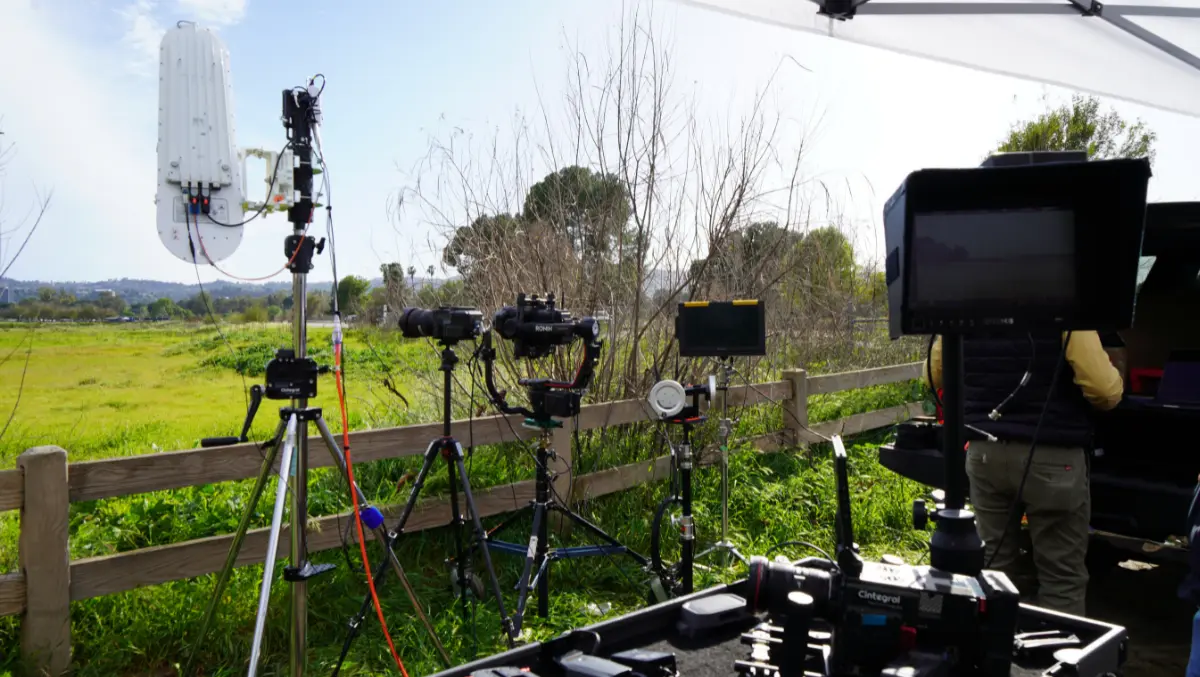
Cintegral uses Taara light links for remote film sets
Thu, 16th Apr 2026
Cintegral is using Taara's light-based wireless technology for remote film, television and live media production. It says the system is being used in work for studios and streaming groups, including Disney, Netflix and Amazon Studios.
The arrangement centres on Cintegral's ST 2110 Fibre-over-Air setup, which uses Taara Lightbridge to send video and production data between locations without laying cable. This lets crews move material in real time rather than storing footage locally and later carrying it to post-production teams.
Cintegral specialises in production technology for broadcast, sport and screen projects. It has been testing the Taara system as part of a portable offering for situations where conventional fibre infrastructure is difficult or impractical to install.
According to Cintegral, the setup supports real-time streaming of 4K JPEGXS and 8K RAW footage between on-location teams and production staff elsewhere on site. The workflow is designed to enable directors, DOPs, DITs, dailies, editors, VFX teams, broadcasters, and technical staff to collaborate during a shoot rather than waiting until the end of the day.
The use of wireless optical links reflects a broader push in production to move large volumes of video quickly between field locations and post-production teams. Remote sets, temporary venues and outside broadcast environments often rely on local storage, satellite links or temporary cabling, each of which can add delay, cost or logistical complexity.
Taara emerged from X, Google's Moonshot Factory, and has focused on transmitting data through narrow beams of light between fixed points. In media production, it is positioning that approach as an alternative for crews that need a high-bandwidth link but cannot justify trenching for fibre or waiting for a fixed-line build.
The move takes the technology beyond telecom applications and into production and private network settings. Taara says the Cintegral deployment shows how the system can be adapted for sectors that need mobility and immediate access to large data transfers.
On-Set Links
For production companies, one attraction is the speed of setup. The wireless bridge can be installed without the trenching, spectrum licensing or long lead times that often come with conventional infrastructure.
In practical terms, a set can connect cameras, editing stations and review points across a site with less dependence on physical cable runs. For sports and live broadcast work, where locations can change quickly, and infrastructure is often temporary, that flexibility can affect how quickly teams can begin operating.
The technology is also intended to support collaboration among creative and technical staff in different locations. Directors and editors can review material while shooting continues, while VFX and dailies teams can access footage earlier in the production process.
The release did not disclose financial terms or the scale of Cintegral's deployment. It also did not specify which productions at Disney, Netflix or Amazon Studios are using the system.
Industry Interest
The media sector has been exploring ways to replicate studio-grade links in locations without permanent infrastructure. Higher-resolution formats and more distributed production teams have increased demand for fast data movement on set, especially as streaming platforms and studios seek tighter turnaround between capture and post-production.
Taara says the GSMA has shown interest in developing a case study around the deployment model. That suggests wider industry attention on wireless optical links in private network environments, where operators are weighing bandwidth needs against deployment costs and site constraints.
Mahesh Krishnaswamy, founder and chief executive officer of Taara, described the system as a way to avoid extensive fibre installation on temporary or remote productions. "You shouldn't have to dig or lay miles of fiber just to tell a great story. With Taara, we aren't building networks - we're beaming them. We're giving production teams the power to deploy fiber-class connectivity out of thin air, exactly when and where the shoot demands it," he said.
Dane Brehm, chief executive officer of Cintegral, said the company sees the technology as a way to extend advanced production workflows beyond traditional studio environments. "Our goal with ST 2110 Fibre-over-Air is to bring high-performance production workflows to any environment, without being limited by location," he said. "What Taara's technology enables us to do is extend that capability to places where connectivity would normally be a bottleneck, allowing real-time collaboration between crews, directors, and editors on set."