

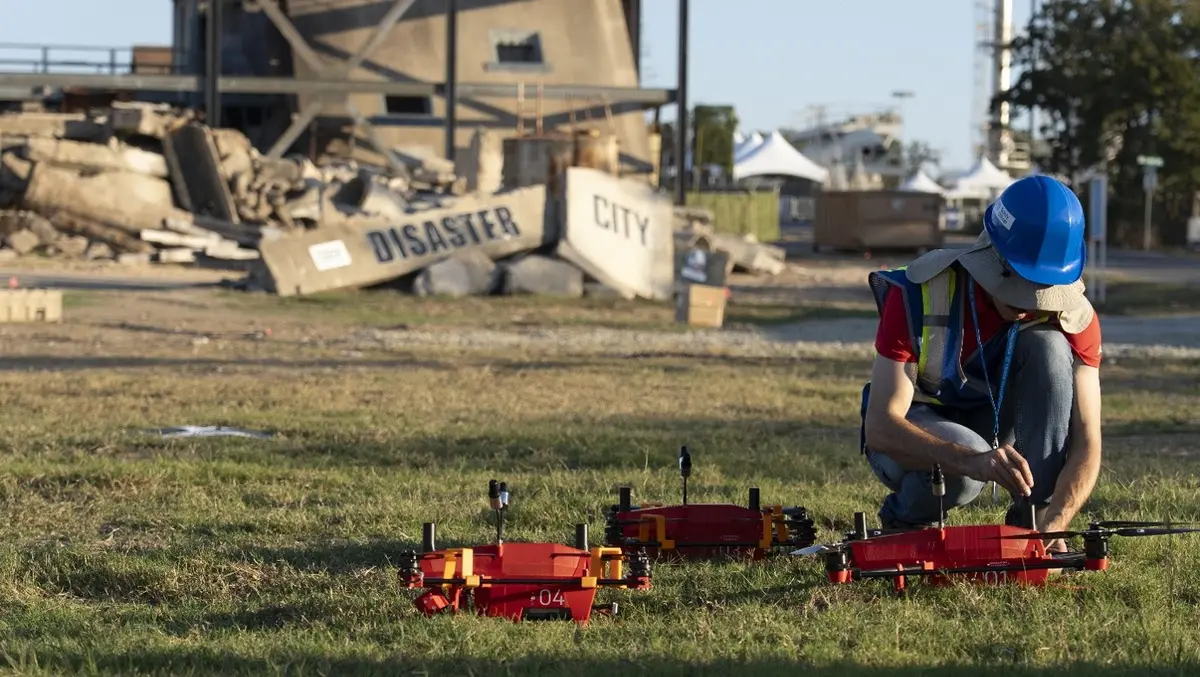

TEEX hosted the finals of the DARPA Triage Challenge at Disaster City in College Station, bringing together more than 100 participants competing for more than USD $3 million in prize money.
Autonomous drones and ground robots worked alongside first responders in simulated mass-casualty incidents designed to test how quickly and accurately teams could identify and assess casualties. Organised by DARPA's Biological Technologies Office, the challenge focused on technology for use when medical staff and time are limited.
Teams from the US military, universities, technology companies and start-ups took part. Academic entrants included the University of Pennsylvania, Carnegie Mellon University and the University of Maryland. Several private teams also reached the final stages after funding their own participation.
Disaster City, a 52-acre mock community operated by TEEX, provided the setting for the trials. The site includes collapsed structures, rubble piles and a derailed train, allowing organisers to recreate a range of emergency scenarios in a controlled environment.
From a command post, DARPA assessed casualty reports against each patient's simulated injuries and vital signs. Across five competitions, entrants had to locate casualties, triage them, assess visible injuries, read vital signs at a distance and work with human medics.
Each scenario tested different conditions, including a tornado striking a community market, smoke-filled buildings, near-dark night searches and rescue operations in rubble. Scores from each round determined which teams advanced to the championship round for the USD $1.5 million top prize.
For Jeremy Pamplin, Program Manager for the DARPA Triage Challenge, the Texas site suited the scale of the exercise.
"To do a project of this size, scale and detail, TEEX just makes sense, bringing the DARPA Triage Challenge Finals to Disaster City," said Pamplin.
"We did this challenge to be the most realistic, repeatable and rigorous testbed for assessing medical technologies ever created, so all the hands-on logistics and work TEEX has done helped make that possible," he said.
Self-funded team
One of the few self-funded finalists was DRONE, short for Disaster Response Observation Network for Emergencies, based in Hawaii. The team is made up of Dr Bob Nakata and his daughter Angelina, a computer science student at Northeastern University. It placed second during the first trials of the competition.
Asked what reaching the finals meant to his family, Nakata pointed to both the practical and personal value of the effort.
"To me, this is being able to see my academic research become material and lifesaving," Nakata said. "For my daughter, she has already gotten two or three job offers, and to see her foot get in the door through this has been worth all the hard work. Also, the prize money wouldn't hurt to pay for Angelina's college tuition."
The event also included an expo where public and private organisations presented medical and emergency response tools. It ran alongside the competition, which relied on hundreds of researchers, medics, support staff, investors and role players.
Staged realism
The exercise required months of planning. Organisers timed the movement of actors playing civilians through multiple preparation stations, including scripting, clothing changes, safety briefings and mock-injury make-up.
Ray Ivie, Director of the TEEX Office of Research, said the agency's role went well beyond providing a venue.
"TEEX is extremely grateful to help bring the finals of the DARPA Triage Challenge to life here, and working with such an important agency for American innovation, research and defense is a perfect fit for the kind of subject matter experts and facilities we have at our agency," Ivie said.
"This was a multi-month planning process, and to see the kinds of cutting-edge emergency response technology being tested at TEEX shows how dedicated our agency is to saving lives," he said.
Richard Salve, Chief Operating Officer at R2 Medical Group, helped coordinate the actors used in the scenarios. He said the schedule was designed to place participants in position with little margin for delay.
"The first five stations, which include getting your individualized script and itinerary, changing into clothes we provide, and detailed safety instructions for the day, take about 15 minutes, with time for actors to review their scripts before they got to makeup," Salve said.
"After that, we have it timed so that the remaining stations get the actors out onto their challenge stations extremely prepared and knowledgeable about what they're going to do and when they're going to do it, all to reinforce the safety of everyone and the realism of the exercise. Each station has dedicated team members who have also been trained to troubleshoot when a participant needs any kind of assistance. We really thought of everything in the planning process," he said.
Pamplin said TEEX had helped adapt the site from its regular operations to the demands of the challenge.
"All the problems we have had, TEEX has helped solve," he said. "The environment was transformed overnight from TEEX's daily activities to the DARPA Triage Challenge, and every step of the way they helped with planning and changing that infrastructure to put this event together. They have a lot of expertise, and they helped us a lot with scenario development to ensure this felt and looked as real as possible."