

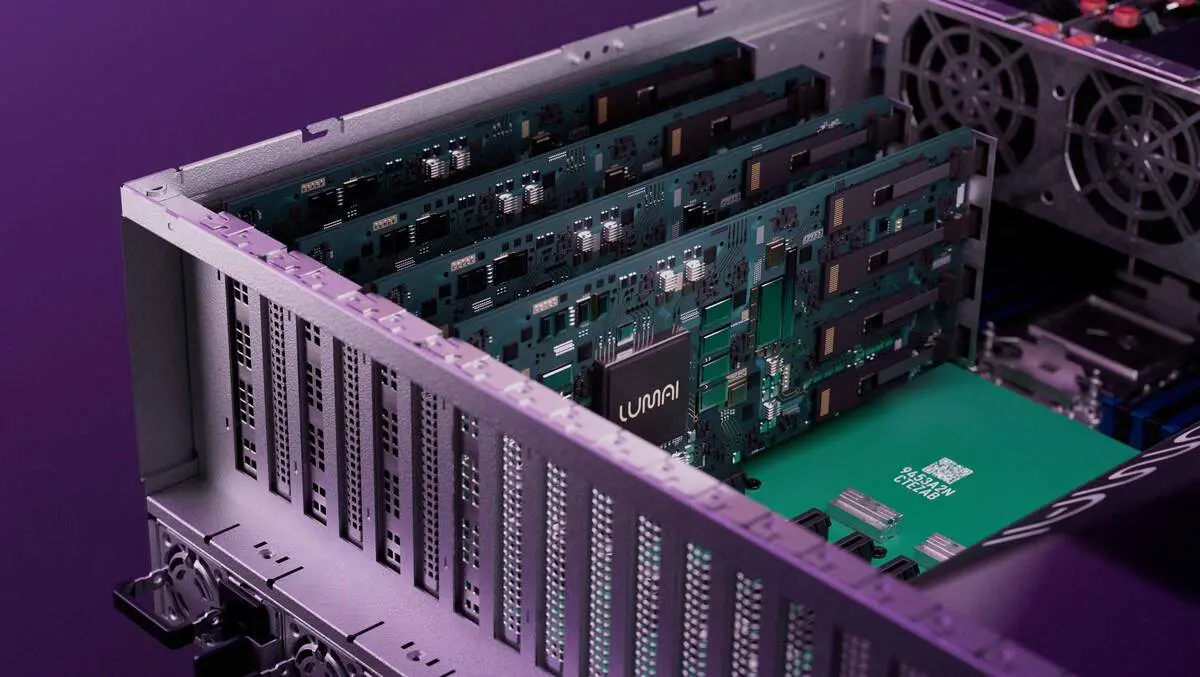
Lumai launches optical Iris Nova server for AI inference
Wed, 29th Apr 2026
Lumai has launched the Iris Nova inference server, which it describes as the first optical computing system to run billion-parameter large language models in real time.
The Oxford-based company is making the new server available for evaluation by hyperscalers, cloud providers, enterprises and research institutions. Iris Nova is the first product in Lumai's Iris server line, which also includes Aura and Tetra.
The launch comes as data centre operators face rising demand for artificial intelligence inference, the stage when trained models generate responses for users. Lumai is positioning optical computing as an alternative to silicon-based processing, using light to perform the core mathematical work of model inference.
According to Lumai, Iris Nova can run real-time inference on Meta's Llama 8B and 70B models through a hybrid processor design. The system combines digital processing for control functions and software with an optical tensor engine for the main compute tasks.
Lumai said the system grew out of research at the University of Oxford. The business was spun out of that work in 2021 and has focused on applying optical methods to AI infrastructure.
Energy pressure
Lumai is entering a market shaped by power constraints as operators build out AI capacity. It cited International Energy Agency projections that global data centre power demand will double by 2030, increasing pressure on operators to boost throughput without a matching rise in electricity use.
The Iris family is designed to address those limits by improving performance per kilowatt. Lumai also said the system can cut energy consumption by up to 90% compared with conventional architectures, though the announcement did not include independent benchmarking.
The company argues that traditional silicon is approaching physical and thermal limits, making further scaling harder and more expensive. By contrast, optical computing uses a three-dimensional volume rather than the two-dimensional layout of standard chips, which Lumai said allows many operations to run simultaneously.
The approach is aimed at compute-heavy inference workloads, including the prefill stage in disaggregated inference systems, where large volumes of tokens are processed before generation begins. Lumai said this results in higher token throughput at lower cost for these tasks.
Post-silicon push
The launch reflects broader efforts across the AI hardware sector to find alternatives to GPU-led systems as model use expands. Optical computing has long been studied in research settings, but commercial products have been limited, particularly for large-scale language model inference.
For Lumai, the release marks a move from laboratory work to a server format intended for data centre deployment. The company said the hybrid design allows integration into existing facilities by combining optical compute with standard digital control systems.
Chief executive and co-founder Dr Xianxin Guo said the market is entering a new phase: "As the industry transitions into the inference era, we are simultaneously crossing the threshold into the post-silicon era. By shifting the computation paradigm from electrons to photons, Lumai can deliver an order-of-magnitude increase in performance with significant energy savings."
Lumai also highlighted support from ARIA, the UK government-backed agency that funds advanced research and invention.
"The demands on existing AI processors necessitate an urgent search for alternative scaling pathways," said Suraj Bramhavar, Program Director, ARIA. "Lumai is leading the charge in demonstrating that optical processors could provide one such pathway, and ARIA is excited to partner with them to explore the shift beyond our traditional digital computing paradigm."
Iris Nova is available now for evaluation. Lumai said later systems in the Iris family will target wider deployment across hyperscale and enterprise settings.