

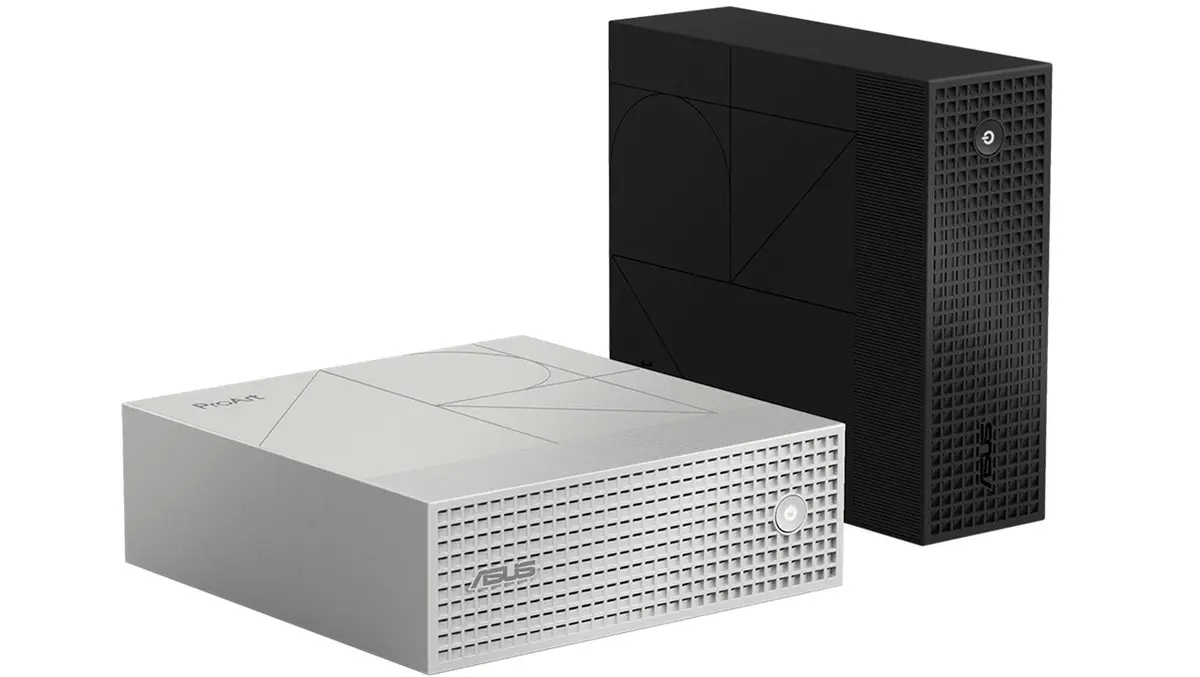

NVIDIA has launched RTX Spark compact desktops from ASUS, Dell and MSI. The dedicated Windows PCs are available now for local artificial intelligence workloads.
The launch extends the RTX Spark line beyond laptops, adding desktop systems designed to run local AI agents, image and video generation, and model fine-tuning on device.
The desktops combine a 20-core Grace CPU with a Blackwell RTX GPU featuring 6,144 CUDA cores and up to 128GB of unified memory, according to NVIDIA. It said the machines can support larger local models while handling creative and development software on a single PC.
The hardware is aimed at users who want a separate machine for persistent AI tasks while keeping a laptop free for travel or other work. Keeping supported models local can also help users avoid cloud API charges and keep processed code and files on the PC, NVIDIA said.
Among the first systems on sale are the ASUS ProArt GR1X mini PC and the MSI EdgeMesa N AI+ Series. Acer, GIGABYTE and HP are also due to add mini PCs, while Microsoft is preparing a Surface RTX Spark Dev Box.
The systems include 10-gigabit Ethernet for moving large model files, datasets and creative assets between desktops and networked storage. NVIDIA said they can run local large language models with up to 120 billion parameters, render 3D scenes larger than 90GB in real time and edit 4:2:2 video in real time.
Software push
The desktop launch also brings broader software support for the RTX Spark family. Native Windows on Arm applications from Adobe, support for DLSS Ray Reconstruction in Blender and local generation workflows in ComfyUI are now available for Spark laptops and compact desktops, NVIDIA said.
For developers, NVIDIA is highlighting native CUDA support and Linux development tools through Windows Subsystem for Linux. It said users can build and run local AI workflows, set up agents with Hermes Agent or NemoClaw blueprints, and fine-tune supported models using Unsloth.
NVIDIA also said Switchyard is now available in Hermes to route agent tasks between local and cloud models. In practice, that means simpler work can stay on the device while more demanding reasoning tasks are sent to cloud models.
NVIDIA described workflows linking Photoshop and ComfyUI through Hermes Agent, allowing creators to use natural-language instructions to turn sketches into rendered images and animations, or to animate images on device by isolating a subject and defining movement. It added that ComfyUI already supports RTX Video Frame Generation and RTX Video HDR, which can expand a generated clip to 60 frames per second and convert it to high dynamic range in the same workflow.
Adobe expansion
Adobe is extending native Windows on Arm support and RTX acceleration across its software for the Spark platform, according to NVIDIA. Premiere Pro now supports TensorRT-RTX acceleration for features including Enhance Speech, Object Mask, Scene Edit Detection and Auto Reframe.
The update also improves support for professional video formats including Canon RAW, Red RAW, ARRI RAW, ARRICORE, ARRI HDE, H.264 and HEVC in MXF, ProRes RAW and long-GOP video, NVIDIA said. It added that editors can see more than 50% faster turnaround on everyday H.264 deliverables.
Photoshop now adds TensorRT-RTX acceleration for the Remove Tool and native Camera Raw support for Arm-based RTX Spark systems, according to NVIDIA. Adobe Substance 3D Painter 12.2 is also available in public beta with native Arm support, while Illustrator and InDesign now have native Windows on Arm versions optimised for RTX Spark.
Illustrator delivers up to 30% higher performance than the emulated version, NVIDIA said. The updates are intended to bring more of Adobe's creative software stack to Arm-based Spark devices without relying on compatibility layers.
Blender and Windows
Elsewhere in the software ecosystem, Blender 5.3 now integrates DLSS 4.5 Ray Reconstruction into the Cycles viewport. NVIDIA said this gives artists near-final-quality lighting, reflections and materials in the interactive viewport in real time, rather than a noisy preview that gradually resolves.
The announcement also coincided with wider Windows AI updates. NVIDIA said its DGX Station for Windows platform, based on the GB300 Grace Blackwell Ultra Desktop Superchip, will support Windows Server 2028, broadening deployment options for organisations that want AI systems closer to their applications and data.
At the same time, Microsoft is allowing developers to bring GGUF models from Hugging Face into Windows ML through the llama.cpp backend. NVIDIA also pointed to an experimental DxCGC backend for running machine learning models through DirectX 12, allowing developers to execute AI workloads alongside graphics.
The move reflects a broader effort to position local AI on Windows PCs as an option for creative work, software development and always-on agents, with compact desktops serving as a dedicated machine in that setup.