


.webp)
SambaNova and Intel have announced a hardware design for agentic AI inference that combines GPUs, SambaNova RDUs and Intel Xeon 6 CPUs.
The design targets enterprises, cloud providers and sovereign AI programmes looking to run coding agents and other agentic workloads at scale. Under the agreement, SambaNova will standardise on Xeon 6 as the host CPU paired with its RDUs.
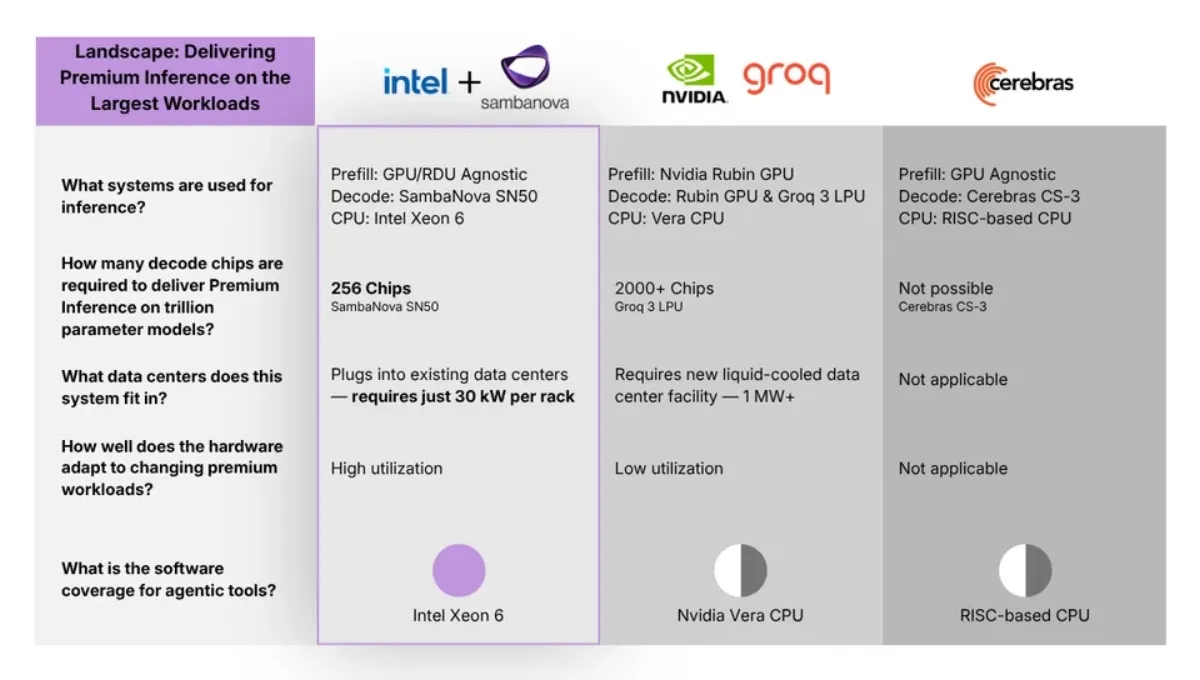
The companies are presenting the design as an alternative to GPU-only AI infrastructure as coding agents place more strain on existing systems. Their approach assigns different parts of the inference process to different processors: GPUs handle prefill, SambaNova RDUs handle decode, and Xeon 6 CPUs manage orchestration and agent tasks.
Hybrid design
The arrangement is intended to fit into existing air-cooled data centres, avoiding the need to build new facilities to meet rising AI demand. SambaNova argues that coding agents and related workloads expose bottlenecks in GPU-only environments because these tasks extend beyond model inference into code compilation, tool use, database access and workflow coordination.
Rodrigo Liang, Chief Executive Officer and Co-Founder of SambaNova Systems, described the approach as a practical deployment model for customers already operating conventional data centres. "Agentic AI is moving into production - and the winning pattern we're seeing is GPUs to start the job, Intel Xeon 6 to run it, and SambaNova RDUs to finish it fast," he said.
"Together with Intel, we're giving customers a blueprint they can deploy in existing air-cooled data centers, with broad x86 coverage for the coding agents and tools they already use today," Liang added.
Intel framed the announcement around the role of x86 processors in enterprise and cloud software environments. Many data centre applications and development tools already run on Xeon, which could make a mixed hardware design easier to deploy than more radical architectural shifts.
"The data center software ecosystem is built on x86, and it runs on Xeon-providing a mature, proven foundation that developers, enterprises, and cloud providers rely on at scale," said Kevork Kechichian, Executive Vice President and General Manager of the Data Centre Group at Intel Corporation.
"Workloads of the future will require a heterogeneous mix of computing, and this collaboration with SambaNova delivers a cost‐efficient, high‐performance inference architecture designed to meet customer needs at scale-powered by Xeon 6," Kechichian said.
Agent workloads
The announcement reflects a wider shift in AI infrastructure towards splitting workloads into separate stages. In this model, long prompts are processed during prefill, token generation happens during decode, and agentic tasks such as code execution and tool calling run elsewhere in the system.
SambaNova said its SN50 RDU is designed for high-throughput decode, while Xeon 6 handles system control, task coordination, workload distribution, API execution, code compilation and result validation. It also said Xeon 6 provides the memory bandwidth, PCIe lane density and on-die accelerators needed for the design.
Third-party companies cited by SambaNova pointed to rising demand from coding agents in particular. Daytona, which provides secure coding infrastructure for agentic AI, said growth in machine-generated code is increasing the need for sandboxed environments where code can be compiled and run on CPUs.
"We are seeing AI Agents code output grow exponentially and as a result, Daytona is seeing the need for more and more sandboxes to run and compile this code, which runs on CPUs like Intel's Xeon," said Ivan Burazin, Chief Executive Officer of Daytona.
RadixArk, another company referenced in the announcement, said no single processor type is well suited to every part of an agentic workflow. It argued that combining RDUs for decode with CPUs for tool execution may better reflect how production AI systems are now being built.
"Production inference is moving toward heterogeneous hardware - no single chip type is optimal for every stage of an agentic workflow. What makes the Intel and SambaNova blueprint stand out is that it pairs reconfigurable RDUs for fast decode with Intel Xeon CPUs for agent tool execution - delivering premium performance with fewer chips and full compatibility with the software ecosystem enterprises already run on," said Banghua Zhu, Co-Founder and Chief Technology Officer at RadixArk.
Performance claims
SambaNova also shared internal performance measurements for Xeon 6 in coding-related tasks. It said the processor delivered more than 50% faster LLVM compilation times than Arm-based server CPUs and up to 70% faster vector database performance than available x86-based rivals.
The figures are intended to support the case for using CPUs as an active part of agentic AI systems rather than as background infrastructure. SambaNova said the growth in simultaneous coding agents means CPUs now sit at the centre of task execution, retrieval requests, code builds and encrypted inter-agent messaging.
"When thousands of simultaneous coding agents are generating tool calls, retrieval requests, code builds, and encrypted inter‐agent messages, the CPU is not a background component - it is the system's executive and action layer," said Harry Ault, Chief Revenue Officer of SambaNova.
"Pairing Xeon 6 with SambaNova SN40 and SN50 RDUs gives enterprises and sovereign AI operators deployments that are faster, more cost‐efficient, and purpose‐built for the agentic workloads that are running in production today," Ault said.