

Subco unveils 40,000km Indo-Pacific subsea cable plan
Sun, 4th Oct 2026 (Today).webp)
SUBCO has announced three new subsea cable systems in the Indo-Pacific, with a combined length of more than 40,000km.
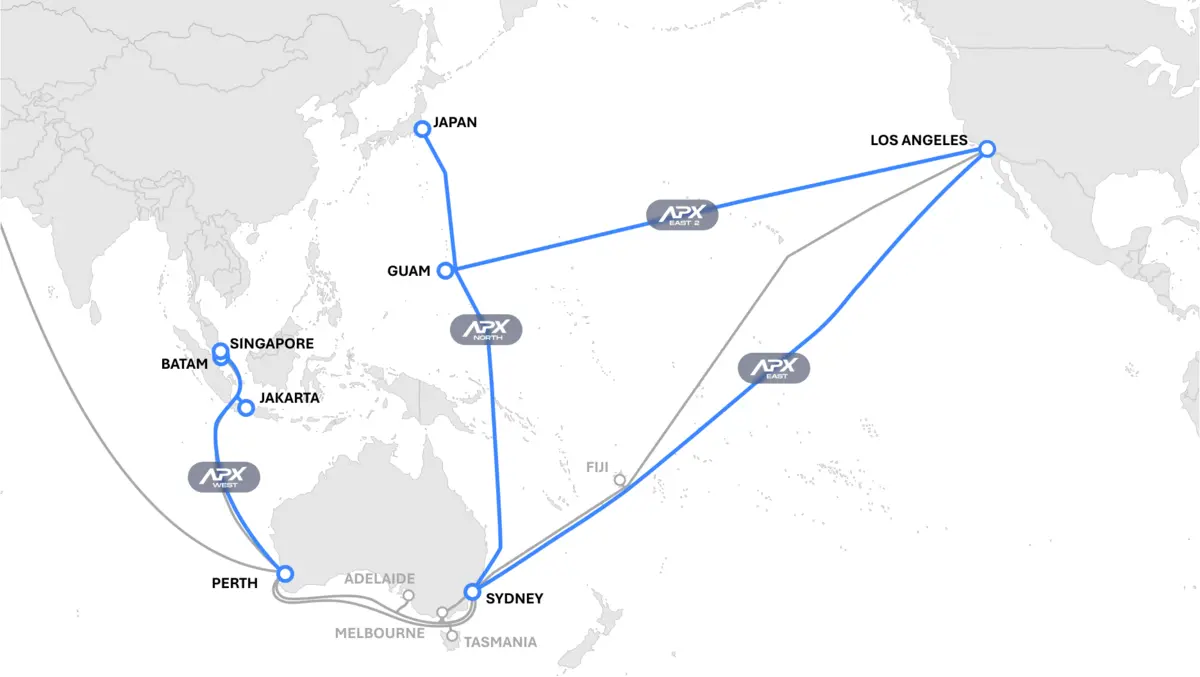
The planned systems are APX North, APX East-2 and APX West. Together, they form what SUBCO described as the largest subsea infrastructure build undertaken by a carrier in the region.
APX North is designed as a 9,500km system with 24 fibre pairs linking Sydney to Japan via Guam. It is intended to create a direct fibre route between Australia and Japan while also making Guam a direct connection point on the route.
The cable will include switched branching units, allowing selected fibre pairs to bypass landing in Guam and operate directly between Australia and Japan.
APX East-2 is planned as a 10,000km, 24-fibre-pair cable between Guam and Los Angeles. The route is intended to provide an alternative path for traffic between Asia and the US, as well as added diversity for links involving Australia and Japan through APX North.
"This segment is vital and will serve as the backbone for trans-Pacific traffic between Asia and the US, as well as providing diverse connectivity for Australia and Japan via APX North. We expect this system to be incredibly popular," said Bevan Slattery, Founder & Co-Chief Executive Officer of SUBCO.
APX West is a 4,600km system with 24 fibre pairs connecting Perth to Singapore, with branches to Jakarta and Batam in Indonesia. SUBCO said the design is intended to support additional resilience and switching between interconnection hubs in Batam and Jakarta.
"Singapore and Indonesia remain critical to Asia's connectivity landscape, and their strategic importance will only grow as bandwidth demand accelerates and new interconnection hubs are needed to deliver greater flexibility and route diversity. We are building as much of that as possible into our system design and making that available to our cornerstone customers through APX West," Slattery said.
AI traffic
SUBCO linked the expansion to rising demand from artificial intelligence workloads and the movement of data across long-distance international networks. In outlining the project, it said the scale of the build reflects a need for substantially more subsea capacity.
Slattery put that view directly: "I know it's ambitious, but it's achievable and it's necessary. We are finalising the details of cable supply and vessels and expect to be Contract in Force on all three systems by early next year."
He added: "People have been slow to understand that AI factories are dead without massive subsea connectivity to carry tokens from factory to customers. Hundreds and hundreds of terabits per second. That's why we are about to undertake the single largest subsea infrastructure build ever by a carrier in the Indo-Pacific. Not only is the build itself huge, but the timeframe is compressed, with over 40,000km of cable to be installed in just over three years. Our team has signed up for the challenge and will grow significantly as each system reaches CIF."
Build plan
SUBCO is targeting completion of all three systems in 2029. It expects all three to reach Contract in Force status in early 2027, with installation then due to take place over a little more than three years.
The announcement expands a portfolio that already includes INDIGO West, INDIGO Central, the Oman Australia Cable and SMAP. SUBCO is also developing APX East, a direct Australia-US system with a target ready-for-service date in 2028, and has announced a Tasmania extension to SMAP known as Bernacchi-1.
The latest projects would add new routes across the Pacific and into South-East Asia as operators and digital infrastructure groups seek route diversity, lower concentration risk and additional landing points. The inclusion of Guam, Singapore, Jakarta and Batam points to a strategy centred on interconnection hubs beyond the busiest established cable corridors.
If completed on the proposed timetable, the programme would mark a sharp increase in SUBCO's construction activity across multiple long-haul systems at once. More than 40,000km of cable is due to be installed in just over three years.