


TalentLMS has published a survey on what it describes as a skills visibility gap in workplaces, based on responses from 536 US employees and 964 managers.
The report suggests many organisations struggle less with a lack of talent than with identifying the skills already present in their workforce. Only 12% of respondents said their organisation did not face skills visibility issues.
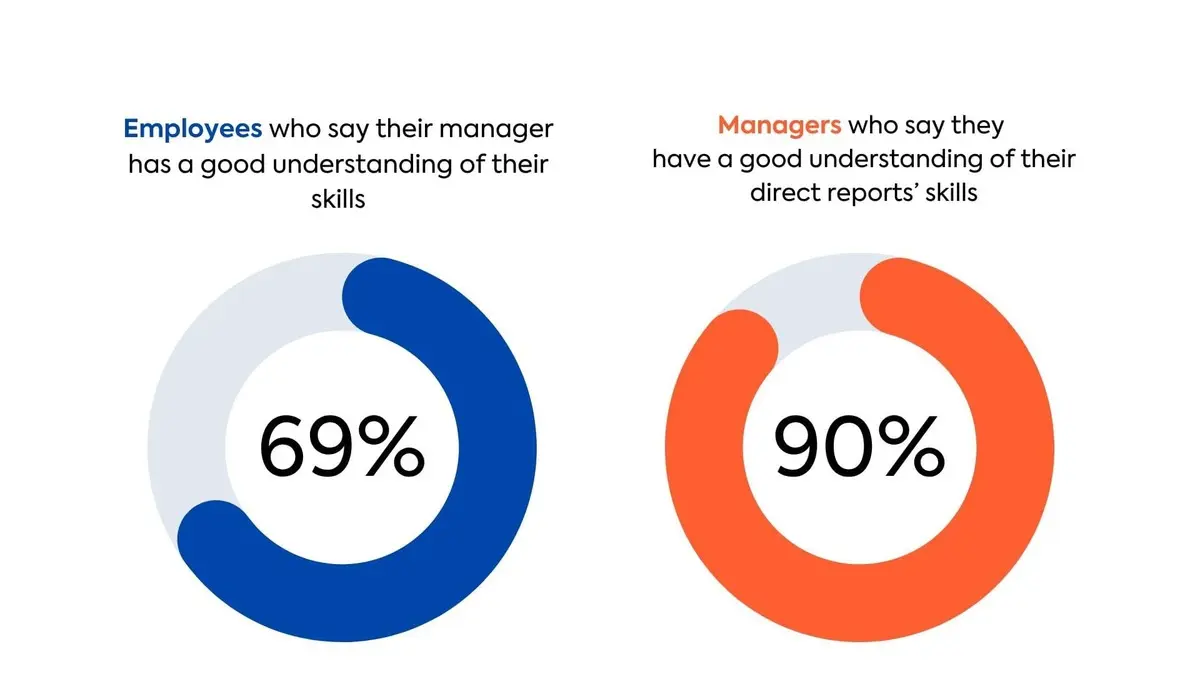
Three gaps stood out in the results. On perception, 90% of managers said they had a good understanding of their direct reports' skills, compared with 69% of employees who said their manager understood their skills.
On development, 90% of managers said they supported their direct reports in building new skills, while 60% of employees said they received that support. On utilisation, 75% of managers said their team's skills were fully used, but 49% of employees said their company underused their skills.
Hidden talent
The survey also pointed to costs linked to poor internal visibility. Half of respondents said their company hired externally for skills that already existed within the business.
Among managers, 57% identified underused skills as the main consequence of poor visibility, while 56% pointed to declining team performance. The findings suggest internal talent mapping remains weak even as employers continue to recruit for hard-to-spot gaps.
Employees also linked the issue to slower career progress. More than half, 56%, said their career growth was held back at least sometimes because their skills went unnoticed.
Nearly a third, 31%, said they would consider leaving their employer because of a lack of skill development opportunities. The survey also found that 40% of respondents believed it was easier to find a new job than to move internally within their current company.
Manager mismatch
The data suggests a notable disconnect between how managers view their support and how employees experience it. It also indicates that skill development often happens only after problems become visible.
Some 42% of employees said managers addressed skill gaps only when performance issues arose. Another 61% of respondents said employees were expected to keep their skills up to date on their own.
Many businesses still rely on informal methods to identify workforce strengths. Only 18% of respondents said their company used a centralised system to track skills.
Instead, they mainly depended on performance reviews, cited by 59% of respondents, and manager observation, cited by 56%. Those approaches can leave organisations reliant on individual judgement rather than shared data.
Practical steps
Respondents highlighted several measures they believed could improve the situation. Regular skills assessments were cited by 47%, while 46% pointed to better manager training to identify and track skills.
The findings come as companies face pressure to make better use of existing staff while retaining workers in a tighter labour market. Internal mobility and development have become more prominent as employers weigh recruitment costs against investment in current teams.
TalentLMS is part of Epignosis. Its chief executive, Dimitris Tsingos, said the problem was not a shortage of skills but a lack of visibility into them.
"The gap isn't skills-it's visibility into them. Companies are rich in talent but poor in insight. Organisations need a clear view not just of employees' existing skills but also of their foundational knowledge, which is becoming increasingly important in the age of AI. Those that build that clarity gain speed, make smarter decisions, and unlock the full value of their workforce."