

AI set to power autonomous workflows & new work models
Thu, 11th Dec 2025
Executives expect artificial intelligence to reshape enterprise work in 2026, shifting focus from standalone tools to end-to-end automated processes and new models for organising people around skills.
Investors and technology leaders say the coming year will test how far companies are prepared to redesign both software and workforce structures to embed AI more deeply into everyday operations.
Two senior figures in venture capital and corporate IT describe a near-term landscape in which AI systems take on whole workflows, while organisations reorganise teams to respond to fast-changing technology and governance demands.
Autonomous workflows
Thomas Cuvelier, Partner at RTP Global, expects a decisive move away from bolt-on AI functionality towards systems that can own and execute complete business processes with little human intervention.
"2026 will be the year of autonomous workflows, where enterprises will shift from 'AI features' to AI workers handling entire processes. This will see AI-native disruptors give software incumbents across a range of industries a shock. With embedded automation from day one, AI-native startups are showing an ability to onboard customers at previously unthinkable speeds and offer software with simplified workflows and greater cost-saving potential. Incumbents can't match this without undertaking the costly and time-intensive process of rebuilding their systems around AI," said Thomas Cuvelier, Partner, RTP Global.
The comments highlight growing pressure on established software providers to re-architect legacy products. Many have added generative AI-based features over the past two years. Cuvelier suggests this incremental approach may not be enough as customers seek tools that can run and improve whole processes, from sales operations to back-office functions.
For startups built around AI from inception, the prospect is different. Their infrastructure and user experience can be designed around automation and orchestration rather than human-centric workflows. That can reduce configuration times and reliance on manual inputs, which investors see as an advantage in enterprise sales.
New AI capabilities
Cuvelier points to several technical areas that he expects to attract greater commercial attention next year, particularly among early-stage companies.
"From an innovation perspective, I'm closely monitoring self-correcting workflows, secure memory and multi-agent collaboration as exciting nascent AI applications that startups will commercialise further in 2026. We'll be hearing more about these concepts, and the young companies leading their development, in the coming months," said Cuvelier.
Self-correcting workflows refer to AI systems that can detect and fix their own mistakes in real time, using feedback loops rather than relying solely on human supervision. Secure memory addresses how AI agents store and re-use sensitive organisational data while complying with security and privacy requirements. Multi-agent collaboration involves several specialised AI agents working together on complex tasks, often in coordination with human employees.
These capabilities are seen as important building blocks if AI is to handle more critical processes across industries such as finance, logistics and customer service, where error rates and data protection obligations are tightly controlled.
Workforce design
Alongside technical change, corporate IT leaders are focusing on how AI adoption alters organisational design and workforce planning.
Orla Daly, Chief Information Officer at Skillsoft, expects more companies to reorganise teams around skills and capabilities rather than traditional hierarchies.
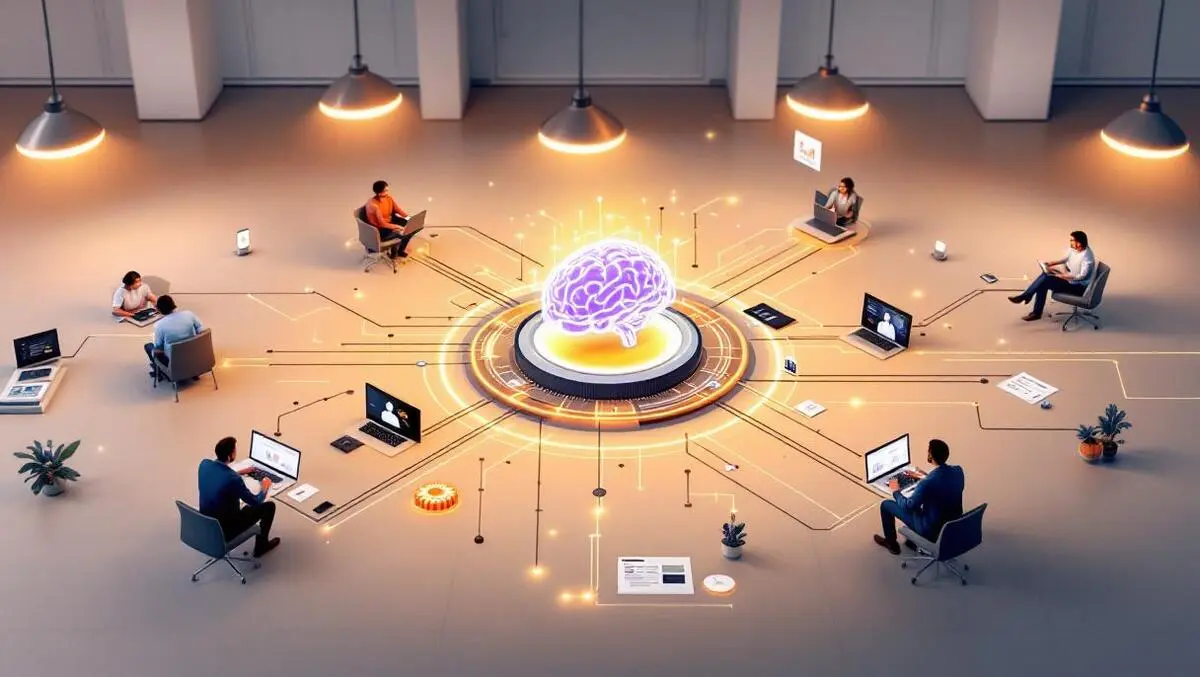
"Organisations that flex their workforce based on priorities, and build teams based on skills versus reporting lines will be better equipped to meet the demands of a fast-changing, AI-enabled workplace. More businesses will implement a hub-and-spoke model to take advantage of AI and understand its implications in reshaping an organisation, where the hub establishes a framework and governance, and spokes establish agile cross-functional business and tech expertise to solve problems collaboratively. Teams are increasingly built around capability and purpose, meaning they move faster, break down silos, and adapt more easily. As AI tools multiply, strong guardrails and a willingness to experiment will be key, but so will the discipline to validate what works. The future of work will belong to organisations that redesign the human side of their workforce with flexibility, clarity, and trust at the core," said Orla Daly, Chief Information Officer, Skillsoft.
Her comments underscore the need for governance and experimentation to run in parallel. The hub-and-spoke model she describes is already appearing in some large enterprises, where central AI teams set standards for data use, risk and vendor selection, while business units develop specific applications.
As more AI tools reach employees across functions, organisations will need to balance openness to new use cases with formal processes for testing, validation and compliance.
"The future of work will belong to organisations that redesign the human side of their workforce with flexibility, clarity, and trust at the core," said Daly.